
Will I Owe Money After a Tennessee Foreclosure? Deficiency Judgments in Plain English
If a Tennessee foreclosure is on the horizon, the fear that hides behind every other worry is usually the same: 'Even after the bank takes the house, will I still owe them money for years?'
The honest answer is: in Tennessee, you can — but it is limited by statute, it is far from automatic, and a sale before the auction usually avoids it entirely. Here is the plain-English version of how Tennessee deficiency judgments work, what protects you, and how to keep them out of your life.
Get Your Free Cash Offer Now!
Fill out this form to get your no-obligation all cash offer started!
Get Your Free Offer TODAY!
Fill In This Form To Get Your No-Obligation All Cash Offer Started!
What a Deficiency Judgment Actually Is
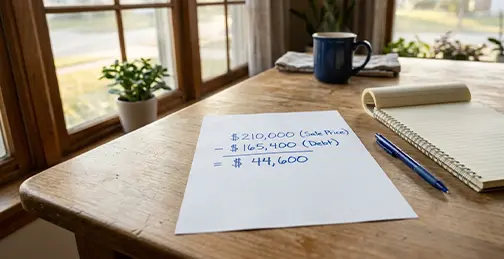
A deficiency is the gap between what you owed and what your house brought in at a foreclosure sale. If you owed $230,000 and the home sold at the trustee auction for $200,000, the deficiency is $30,000. A deficiency judgment is a court order that lets the lender try to collect that gap from you personally — through wage garnishment, bank levy, or a judgment lien.
Tennessee allows deficiency judgments after a non-judicial foreclosure under Tenn. Code Ann. § 35-5-117, but the statute also includes the most important homeowner protection in the entire chapter: if you can show that the home sold for materially less than its fair market value at the time of the sale, the deficiency is limited to the total debt minus the actual fair market value of the property — not the lower sale price.

The Fair-Market-Value Defense, Plain
Think about it this way. If you owed $230,000, the home was actually worth $225,000, and the bank credit-bid only $200,000 at the trustee sale, the bank cannot turn around and sue you for the full $30,000 gap. Under § 35-5-117, your deficiency is capped at $5,000 — the difference between the debt and the home's true value, not the artificially low auction price. This is the statute working for you, and it is exactly why lenders are increasingly cautious about pursuing deficiencies in Tennessee unless the math is clearly in their favor.
The catch is that you have to prove fair market value. That usually means evidence — a recent appraisal, comparable sales data, a broker's price opinion. Document everything you can before any sale, and talk to a Tennessee real estate attorney as soon as a deficiency comes into view.
How Long Does the Lender Have?
Roughly two years. The lender generally has to file a motion or action for a deficiency judgment within two years of the trustee sale, depending on the procedural posture. See § 35-5-117 and consult an attorney for your specific situation. The takeaway: a deficiency is not a sword that hangs over you forever — but it is real for a couple of years if a meaningful gap exists. The Legal Aid Society of Middle Tennessee & the Cumberlands can help if you qualify financially.
Why Selling Before the Sale Avoids the Whole Question
Here is the cleanest version of the argument for acting before the trustee sale. In a regular sale — including a cash sale to Whitley Hamilton — the home sells at or near its real value, which usually means the loan gets paid off in full at closing. No gap, no deficiency, no surprise lawsuit two years later. Even when the home is worth slightly less than the loan balance, a controlled pre-foreclosure sale gives you the option to negotiate the shortfall with the lender as part of the closing — far better odds than letting a trustee auction generate a gap and then defending the deficiency motion afterward.
In short: a Tennessee homeowner who closes a cash sale at fair value before the trustee sale generally walks away with no deficiency, no foreclosure on their credit report, and any remaining equity in their pocket. That same homeowner, after a completed foreclosure, faces the harder math — and sometimes a deficiency motion within the two-year window.
What to Do Right Now
- Get a realistic value on your home — not a Zillow guess, an actual market read. We will give you one for free.
- Pull your loan payoff figure from your servicer. You need exact numbers, not estimates.
- If a deficiency or short-sale situation looks likely, talk to a Tennessee attorney — and contact the Legal Aid Society of Middle Tennessee & the Cumberlands if cost is a barrier.
- Get a written cash offer in hand so you know what a clean, pre-foreclosure sale would clear.



Sell Your House in Tennessee – Get a Cash Offer Now
Selling your home doesn’t have to be hard, we offer a fast, fair cash offer with no repairs, commissions or stress. Contact us today to get started and see how easy it can be to sell your house on your terms.
Get Your Free Offer TODAY!
Fill In This Form To Get Your No-Obligation All Cash Offer Started!