
Sell a Home in Tennessee Tax Sale or Behind on Property Taxes — Before the Redemption Clock Shrinks
A property tax bill is a strange kind of debt. It is usually small compared to your mortgage and small compared to your home's value — and that is exactly what makes it so easy to put off until it becomes the thing that takes the house.
If you are behind on property taxes in Kingsport, Johnson City, Bristol, or anywhere across Northeast Tennessee, the most important thing to understand is that Tennessee handles tax sales differently than most of the country. The sale itself runs through the Chancery Court — not the trustee's office. And the window to get the property back after a sale is not a flat number of months. It is a sliding scale that shrinks the longer the taxes have gone unpaid — down to as little as 30 days for property the court finds vacant and abandoned.
We're Korey Whitley and Evan, the owners of Whitley Hamilton Home Buyers. I'm Korey, born and raised in Kingsport, and I have spent more than ten years buying homes across the Tri-Cities. We are not a national service running ads from somewhere else. We are your neighbors. The reason this page exists is simple: people lose homes worth hundreds of thousands of dollars over tax bills in the low five figures every year in Tennessee, and they should not have to.
Below is the honest, plain-language version of how Tennessee tax sales actually work, the four redemption windows under T.C.A. § 67-5-2701, the math of what redeeming actually costs, and where a cash sale fits if redemption is not realistic. No pressure. No salespeople. Just the facts and an option.
Get Your Free Cash Offer Now!
Fill out this form to get your no-obligation all cash offer started!
Get Your Free Offer TODAY!
Fill In This Form To Get Your No-Obligation All Cash Offer Started!
How Tennessee Property-Tax Delinquency Becomes a Tax Sale
Tennessee property taxes are due each year on the first Monday in October. They become delinquent on March 1 of the following year, and interest plus penalties begin compounding under Tenn. Code § 67-5-2010 — roughly 1.5 percent per month, which is about 18 percent per year. The county trustee continues accepting payments after delinquency, but the longer the balance sits, the heavier it gets.
After a period of delinquency — which varies by county and trustee discretion, but commonly runs two to five years — the county refers the parcel to the delinquent tax attorney, who files suit in Chancery Court. Once the Chancery Court orders the sale, the parcel goes to auction. The lender's role is irrelevant; this is the county collecting taxes, and the proceeds are applied to the delinquent taxes, penalties, interest, and court costs first.
The Four Redemption Windows Under § 67-5-2701
Here is the part most Tennessee owners do not realize. After the Chancery Court enters the order confirming the sale, the former owner has a window of time to redeem the property — meaning to pay everything owed and take the property back. Tenn. Code Ann. § 67-5-2701 sets the window on a sliding scale based on how many years the taxes have been delinquent on that specific parcel.
| Years of Delinquency | Redemption Window | Notes |
|---|---|---|
| 5 years or fewer | 1 Year | The default — applies unless court finds evidence to shorten |
| More than 5, less than 8 | 180 days | Window shrinks meaningfully — start counting from order confirming sale |
| 8 years or more | 90 days | Short window — owner is generally chasing the calendar |
| Vacant and abandoned | 30 days | Regardless of years delinquent — the trap that catches inherited/absentee owners |
These windows start running from the date the Chancery Court enters the order confirming the sale — not the date the auction itself happens. If you receive a notice that the order has been entered, the clock has already begun.
What Redemption Actually Costs
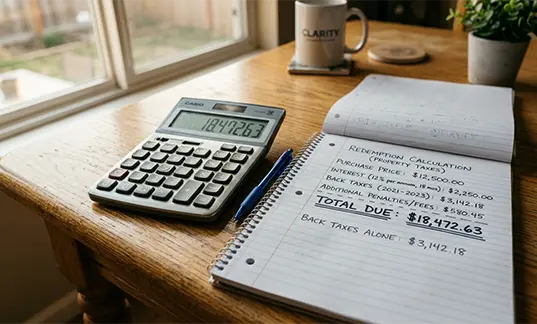
Most owners assume redemption means just paying the delinquent taxes. It does not. To redeem under § 67-5-2701, you (or an heir, lien holder, or assignee) must file a Motion to Redeem with the Chancery Court Clerk and pay all of the following, into the court's hands:
- The full purchase price the buyer paid at the tax sale
- Interest at 12% per annum on that purchase price — running from the date the purchaser paid until the date you file the motion
- All delinquent taxes, penalties, and interest under § 67-5-2010
- Court costs
- Potentially, claims by the purchaser for property preservation expenses (recording fees, additional years' taxes paid, expenses to preserve value)
Worked example. Suppose a tax-sale purchaser paid $35,000 at the auction six months ago, the back taxes total $14,000, court costs are $1,500, and the purchaser is claiming $2,000 in preservation expenses. The 12% interest on the $35,000 bid for six months is $2,100. The total redemption is roughly $54,600 — for a home that may be worth $250,000. The equity is real,
Your Real Options
Pay the trustee before the chancery suit is filed. If your taxes are not yet in chancery, contact your county trustee about payment plans. Counties have discretion, and many will work with owners who reach out before the lawsuit is filed.
Free counseling. THDA is the HUD-approved Tennessee state housing counseling agency. Legal Aid Society of Middle Tennessee & the Cumberlands provides free legal help to qualifying owners.
Pre-sale: sell the home. A regular sale (cash or financed) before the chancery sale lets you pay off the taxes at closing and walk away with the equity. This is the cleanest option and the one most owners overlook.
Post-sale: redeem. If you have the money, file the Motion to Redeem with the Chancery Court Clerk within your tier of the sliding scale. Talk to a Tennessee attorney before filing; the math is unforgiving.
Post-sale: sell inside the redemption window. This is what we do most often. Whitley Hamilton can close fast enough — typically 7 to 14 days — to acquire the property during your redemption window, fund the redemption at closing, and pay you the remaining equity. The equity goes to you, not the tax-sale purchaser.
What a Cash Sale With Whitley Hamilton Looks Like
- Step 1: Call us or fill out the form. Tell us the property address, roughly how many years the taxes have been delinquent, and where you are in the process (pre-sale, post-sale, vacant-property notice).
- Step 2: We pull the chancery court file and confirm the redemption window that actually applies to your parcel. No guessing.
- Step 3: We make a fair cash offer in writing, often within 24 hours, with the redemption math shown.
- Step 4: We coordinate with the Chancery Court Clerk and a licensed Tennessee title company to schedule closing inside your redemption window.
- Step 5: At closing, the redemption is funded, the property transfers, and the remaining equity goes to you.



Talk to a Neighbor
If a Tennessee tax sale is anywhere in your timeline, we will give you our honest read on where you actually stand — which sliding-scale tier applies to your parcel, what redemption would actually cost, and what selling would clear. No pressure, no obligation. People come first.
Get Your Free Offer TODAY!
Fill In This Form To Get Your No-Obligation All Cash Offer Started!
Whitley Hamilton Home Buyers serves homeowners throughout Kingsport, Johnson City, Bristol, Jonesborough, Bluff City, Church Hill, Mount Carmel, Gray, and communities across the Tri-Cities and Northeast Tennessee — Sullivan, Washington, Hawkins, Carter, and Greene counties.